
New UNESCO Policy Brief Calls for Scaling Health Education Through Open Educational Resources
September 8, 2026/Educational Technology & AI, Latest News, Open-Access, Research, Grants & Initiatives, Uncategorized

A new policy brief published in UNESCO’s Open Solutions series argues that health professions education cannot scale while every institution builds the same foundational curriculum on its own.
The world will be short more than 11 million health workers by 2030, with the deepest shortfalls in low- and middle-income countries. Training capacity has to grow. But foundational content is still produced institution by institution: each develops its own materials, largely in isolation, then carries the cost of keeping them current as medical knowledge moves.
A policy brief published by UNESCO argues that this is a solvable structural problem rather than an unavoidable one. Scaling Health Education through Open Educational Resources, Brief 02 in UNESCO’s Open Solutions brief series, makes the case for treating openly licensed, modular content as shared curricular infrastructure that institutions adapt to their own learners, languages, and clinical contexts.
UNESCO invited a team of ScholarRx educators — Dr Tao Le of the University of Louisville School of Medicine, Dr Jeremy Richards of Harvard Medical School, Dr Catarina Pais Rodrigues, and Jeff Downing — together with Dr Charles Prober of Stanford University School of Medicine to author the brief. It was independently peer-reviewed by Dr David Atchoarena, former Executive Director of the WHO Academy, and Dr Cathy Casserly before publication by UNESCO’s Communication and Information Sector.
The brief uses the ScholarRx ecosystem as an illustrative case study, and includes a section on that model’s current limitations. UNESCO states explicitly that the case study is not an endorsement of ScholarRx or of any commercial provider.
What the brief argues
Open content on its own is not the answer, and the brief is direct about why. Most existing OER is not aligned to the competency and accreditation frameworks that formal curricula are built on. Academic culture still treats adapting someone else’s material as lesser work than writing your own. Quality assurance is inconsistent, interoperability standards for modular curricular content barely exist, and funding arrives in grant cycles that reinforce OER’s status as a pilot rather than infrastructure.
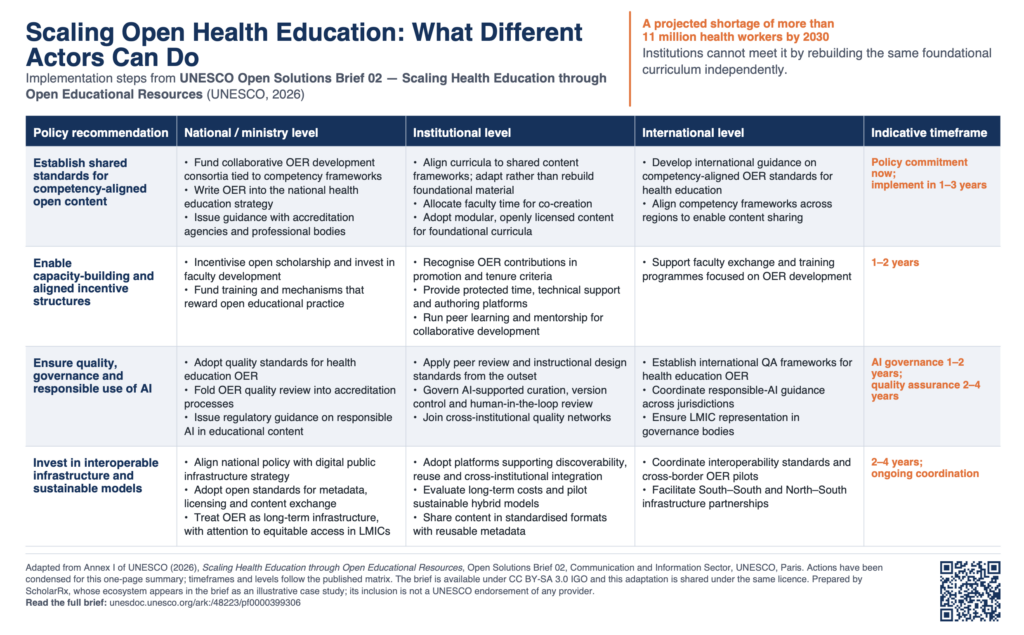
Four priorities follow from that diagnosis: shared standards for competency-aligned open content; capacity and incentives that make open practice worth a faculty member’s time, including recognition in promotion and tenure; quality assurance and governance embedded at the point of content creation, with AI used under meaningful human oversight; and interoperable infrastructure funded as a long-term public system. Annex I translates each one into specific actions at national, institutional, and international levels, with indicative timeframes.
The evidence base is stronger than many assume. A synthesis covering more than 121,000 learners found outcomes with open resources equal to or better than commercial alternatives. The Open Resources for Nursing (Open RN) initiative held course completion rates steady while improving success rates among non-White students, and projected that five open nursing textbooks across 16 Wisconsin colleges would save more than 5,700 students roughly US$1.5 million a year in textbook costs.
From policy to practice
The case study section documents what shared authoring produces in practice. Hanoi Medical University, Thai Nguyen University of Medicine and Pharmacy, and Nam Dinh University of Nursing built 39 Rx Bricks together for a Vietnamese midwifery programme. Harvard Medical School and Johns Hopkins co-developed openly licensed neurology clerkship resources, with results published in Neurology: Education. Across the network, more than 180 institutions in over 140 countries now contribute to or draw on the platform.
The brief is careful about what that does and does not prove. Evidence on learning outcomes rests on a small number of studies, long-term sustainability data across diverse settings does not yet exist, and a model that depends on a coordinating organization raises real questions about replicability. Independent evaluation and wider piloting come before generalized policy conclusions.
What the case study demonstrates is that shared curricular infrastructure can be built. The harder work is policy: standards, incentives, governance, and financing. The brief closes on the argument that knowledge, and the infrastructure that carries it, is a public good. The people it reaches in health professions education are students at institutions that can’t afford to build everything themselves, and the patients they go on to treat.
Read the full brief: Scaling Health Education through Open Educational Resources (UNESCO, 2026).