
TAI in Practice: What Our Latest Faculty and Learner Data Shows
Faculty-authored learning remains at the center of medical education. The question for many institutions is whether artificial intelligence can help educators create that content more efficiently without diminishing the student experience.
New ScholarRx data from the 2025–26 academic year offers an early answer.
The finding
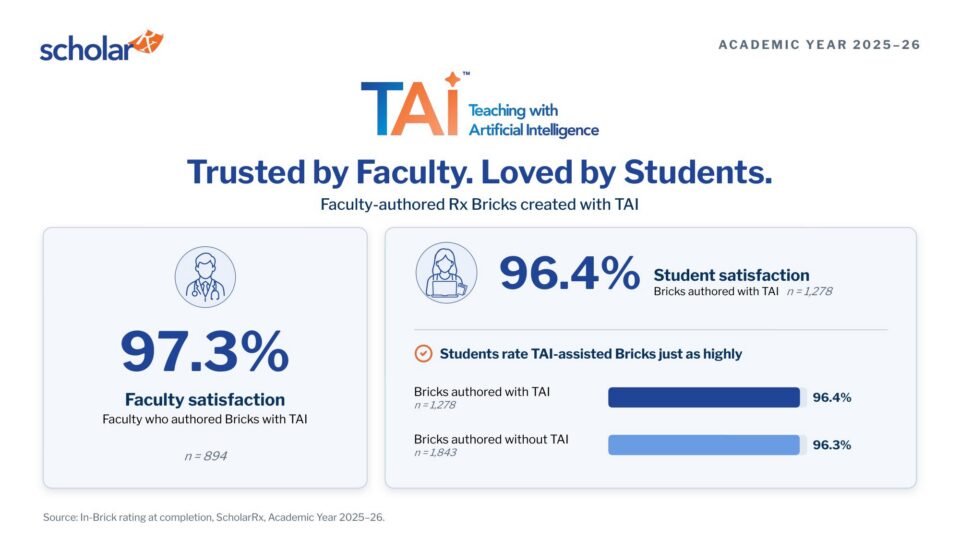
Rx Bricks® authored with TAI™ (Teaching with Artificial Intelligence), ScholarRx’s AI-enabled faculty assistant within the authoring workflow, earned positive ratings from faculty in 97.3% of 894 evaluations submitted at the end of the authoring process.
Student satisfaction was nearly identical whether or not TAI was used: 96.4% across 1,278 student ratings of Bricks authored with TAI, compared with 96.3% across 1,843 ratings of Bricks authored without it. Published Bricks do not indicate whether TAI assisted the authoring process, so students were rating the learning experience rather than responding to an AI label.
These ratings measure faculty approval and student satisfaction, not learning outcomes or comparative effectiveness.
Why faculty-in-the-lead matters
The goal of AI in medical education should not be to remove educators from content development. Faculty expertise, contextual knowledge, academic judgment, and responsibility for what students learn remain essential, and medical and health professions content demands a high standard of accuracy, instructional quality, and accountability that makes that oversight non-negotiable.
That is the philosophy behind TAI. It is designed as an intelligent faculty assistant that helps educators accelerate parts of the content development process while keeping faculty in control. Faculty review and approve every step, and a published Brick carries the faculty member’s byline, not TAI’s. AI assists the workflow. Educators remain the authors. A faculty-in-the-lead model keeps academic expertise at the center of the process, rather than asking AI to independently determine what students should learn.
What that looks like in practice
Creating high-quality educational content takes significant faculty time, alongside clinical, research, administrative, and teaching responsibilities. Faculty must determine learning objectives, organize information, develop instructional materials, review content for accuracy, and ensure the final resource fits within the broader curriculum.
Within Bricks Create, TAI helps reduce that burden while keeping faculty in the authoring role. Educators can use it to:
- Transform existing materials into structured learning experiences
- Develop and refine learning objectives
- Build outlines and initial drafts
- Revise and improve content through iterative review
- Work through a consistent, staged authoring process
Faculty then apply the expertise AI cannot replace: determining whether material is accurate, appropriate, pedagogically sound, and relevant to their learners and curriculum.
The 97.3% positive faculty rating is an encouraging signal that this balance is working for educators. The value of generative AI here is less about producing text than about reducing the friction of authoring while educational judgment stays with faculty.
What comes next
For medical schools, the next phase of AI adoption is less about whether faculty should use AI and more about defining where, why, and under what conditions it adds educational value. Does an AI-enabled workflow solve a genuine faculty problem? Does it preserve academic oversight? Can educators meaningfully review and modify the output? Does the resulting learning experience continue to meet student expectations?
No single metric can answer every question about the educational impact of AI. But these results are a useful early signal: faculty rate TAI-assisted authoring highly, while student satisfaction with Bricks authored using TAI remains essentially unchanged compared with other Bricks.
That is the model ScholarRx is continuing to build toward: AI that reduces the friction of content creation while keeping faculty expertise, judgment, and accountability at the center of the process.