
New Student Success Bricks Collection to Empower Students and the Faculty Who Support Them

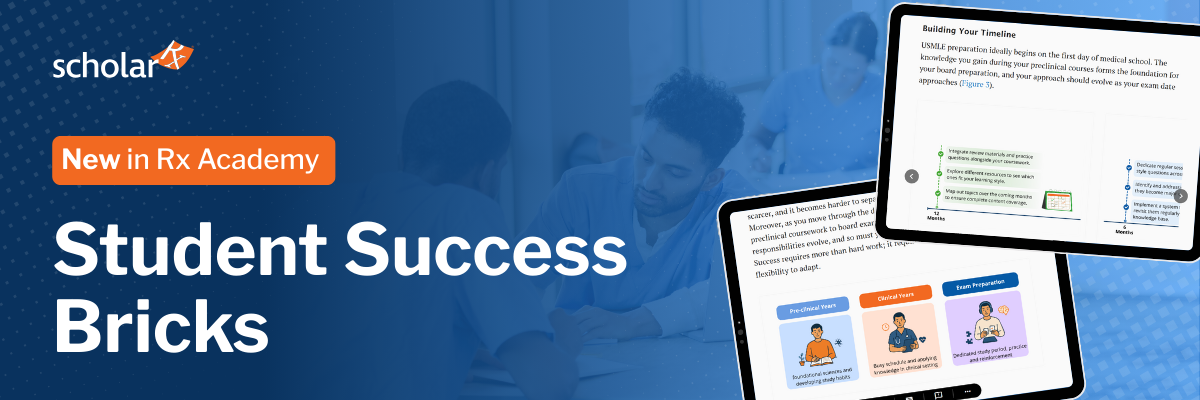
ScholarRx has released a new seven-module Student Success collection inside Rx Academy, a hub designed to help students and faculty get the most out of the ScholarRx learning ecosystem. These Bricks address a core gap in medical education: students face massive workloads but often lack clear guidance on how to learn effectively, manage their time, or study with purpose.
The collection brings together evidence-based learning principles, wellness strategies, and practical tools for academic and exam success. Each Brick is interactive, concise, and built to help students build durable habits that improve performance across preclinical coursework, clinical training, and high-stakes exam preparation.
The collection includes the following Bricks:
1. The Role of Well-Being in Academic Success
Students often believe well-being is something to “fit in later,” but research shows the opposite: cognitive performance, memory, focus, and emotional regulation depend on sleep, nutrition, movement, and mental health. This module helps students understand the link between health and performance, build sustainable habits, and recognize early signs of burnout.
2. Time and Energy Management in Medical School
This Brick confronts the realities of overloaded schedules, procrastination cycles, and unrealistic study routines. It introduces practical tools for prioritization, aligning difficult tasks with peak energy windows, breaking procrastination loops, and building study structures that actually hold up under medical-school pressure.
3. Learning How to Learn
Many students rely on passive strategies; rereading, highlighting, “recognizing” rather than recalling, leading to what psychologists call illusions of competence. This module distills the science behind how memory works and teaches strategies like active recall, spaced repetition, interleaving, SQ3R, dual coding, and the Feynman technique to make learning deeper and more durable.
4. Learning How to Study
While “Learning How to Learn” focuses on cognitive principles, this module focuses on application. Students learn how to build a realistic study plan, set SMART goals, design a study-conducive environment, manage digital distractions, work productively in groups, and use the Rx Study Planner to create a personalized approach.
5. Studying With ScholarRx
This Brick teaches students how to integrate ScholarRx tools: Rx Bricks, Flash Facts, Study Stream, Qmax, and Express Videos into an efficient study workflow. Instead of guessing how to use the platform, students learn when and how each tool should be used for foundation building, review, and assessment. It explains common learning pitfalls and shows how active learning within ScholarRx improves comprehension and long-term retention.
6. Master Multiple-Choice Questions
MCQs dominate medical assessments, yet many students never learn a systematic approach. This Brick breaks down how exam-style questions are structured, introduces a six-step dissection method, and explains how to avoid predictable errors such as misreading the question, falling for plausible distractors, or overthinking. It also reframes MCQs as a learning tool, not just an assessment tool, by emphasizing quality review, error categorization, and deliberate practice.
7. Prepare for USMLE®
This final module guides students through Step 1 and Step 2 CK preparation, from understanding exam structure to building a long-range study timeline. It outlines how to combine resources strategically, how to use question banks effectively, how to maintain motivation over extended study periods, and how to manage test-day pacing and anxiety.
How Faculty Can Use These Resources
Faculty and academic advisors can integrate the Student Success collection directly into advising, orientation programming, and academic support courses. Each Brick can serve as a standalone learning module or as part of a structured curriculum to help students strengthen study skills, self-regulation, and exam readiness. Educators can assign relevant modules before coaching sessions, embed Bricks within existing digital course spaces, or recommend specific Bricks to students who need support in areas like time management, test-taking strategy, or foundational learning skills. Together, these resources offer faculty a scalable toolkit to help students build strong academic habits and confidently navigate the challenges of medical school.